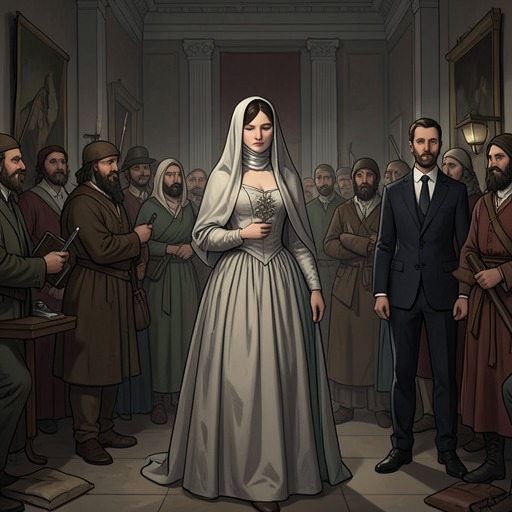
Mutasim the Handsome
Midnight's ChildrenMutasim the Handsome, son of the Nawab of Kif, is introduced as a beautiful young man whose foreign tastes and romantic fixation bring him into collision with Jamila Singer’s guarded privacy. His pursuit of her moves from glimpses through a perforated veil to a nighttime climb into her room; though she ultimately refuses his proposals, he continues to seek her and later dies in the 1965 war.
Identity and Background
Mutasim is the Nawab’s son and the elder brother of the daughter whose engagement brings General Zulfikar’s family to Kif. Having travelled abroad, he wears a beetle-cut and bush-shirts printed with musical notation, foreign street-signs, and images of pink-skinned women. His striking looks are treated as a local spectacle: girls wearing silver nose-jewelry are said to faint when he travels through Kif. Yet his interests seem to lie more with his polo ponies and guitar than with the attention he attracts.
The contrast between his cultivated foreign manner and his innocence about romance becomes important to the episode. He knows the geography of European cities but believes that a charm from the Nawab’s books of spells can make Jamila love him. The narrative presents him as handsome and privileged, but not especially cautious or perceptive.
Courtship and the Love-Charm
When Jamila arrives at the palace concealed in a gold-brocaded burqa, Mutasim becomes obsessed with seeing her face. He has not heard the rumors about her disfigurement and falls in love with the demure eyes he glimpses through her perforated sheet. His desire is therefore built around fragmentary sight: he seeks the hidden face, while Jamila remains protected by the veil and by her refusal to be claimed by another person’s love.
Mutasim tries to befriend Jamila’s brother, Saleem, showing him peacocks brought from Rajasthan before Partition and the palace’s collection of books of spells. He takes Saleem around the polo-field and confides that he has written a love-charm on parchment, intending to press it against Jamila’s hand. When he asks Saleem to bring him close enough to do so, Saleem demands the parchment instead. Mutasim gives it to him, naively assuming the charm will work even if someone else applies it.
The Palace Encounter
At midnight, Saleem wakes still holding Mutasim’s parchment. Following the north wind through the palace, he enters the sleeping quarters and finds Mutasim climbing through a window toward Jamila’s room. The infatuated young man has been emboldened by the wind, which carries the intoxicating scent of ripe hashish plants from the north of Kif.
Hidden in the room’s shadows, Saleem bluffs that he is armed and orders Mutasim to stop. Mutasim is hanging from the window-sill, supporting his full weight, and must choose between holding on and risking being shot or letting go and falling. He recognizes Saleem’s voice and protests that Saleem has no right to be there either, threatening to tell Amina Begum. Saleem points out the weakness of his position; Mutasim pleads not to be shot and is allowed to climb back down. The encounter interrupts his attempt to see Jamila, but does not end his pursuit.
Rejection and Ending
After the nighttime incident, Mutasim persuades his father to make a formal marriage proposal to Jamila’s parents. Jamila rejects him. The account connects her refusal to a life born and raised without love and to her longstanding hatred of people who claim to love her; Mutasim’s beauty, status, and persistence cannot overcome that boundary.
He leaves Kif and goes to Karachi, where Jamila continues to reject his importunate proposals. He eventually joins the Army and becomes a martyr in the 1965 war. His ending gives the romantic subplot a stark historical endpoint: the young man whose story begins with a private fixation is ultimately carried into the war and killed there.
Narrative Role
Mutasim’s pursuit forms a subplot within Saleem’s account of the engagement night. The narrator explicitly sets aside Mutasim’s tragedy to return to Saleem and Jamila alone in the room. This shift makes Mutasim’s thwarted courtship part of the circumstances surrounding Saleem’s own confession: the parchment he gives Saleem is pressed against Jamila’s hand, but the ensuing declaration of love comes from Saleem, not from the charm’s intended suitor.
The episode also turns on the gap between appearance and knowledge. Mutasim’s idealized attraction begins with Jamila’s eyes and his ignorance of the rumors about her face; his belief in the love-charm likewise treats affection as something that might be summoned by an object. His proposals meet a refusal that cannot be magically or socially overruled.